
Summary:
The three-month mark is just a baseline. Some people get two months. Others easily clear five. The variance comes down to simple biology and basic math. Heavy facial muscles chew through the product faster. Smaller, precise doses fade quicker than concentrated ones. Your body eventually grows new nerve endings to bypass the blocked ones. That biological process takes roughly 90 to 120 days. You cannot stop it completely. But you can definitely slow it down. The choices you make in the first 24 hours dictate your results. Let’s see how long Botox lasts.
You want the direct answer. How long does Botox last? The standard clinical answer is three to four months. But your face is not a clinical average. Your results depend heavily on which muscle was treated, how fast your metabolism runs, and exactly how many units your practitioner actually injected. Forehead lines might return in twelve weeks. A jawline slimming treatment often holds its shape for half a year. The timeline varies, and it always has. If you understand the specific factors controlling your Botox result, you can stretch that timeline and stop paying for early top-ups.
How Long Does Botox Last? Average Results by Treatment Area
The face is not a single canvas. It is a collection of muscles constantly pulling against each other. Some pull harder. Those require more units. They also regain their strength faster. Expecting the delicate skin around your eyes to match the heavy muscles of your jaw simply sets you up for disappointment. A single, universal timeline does not exist.
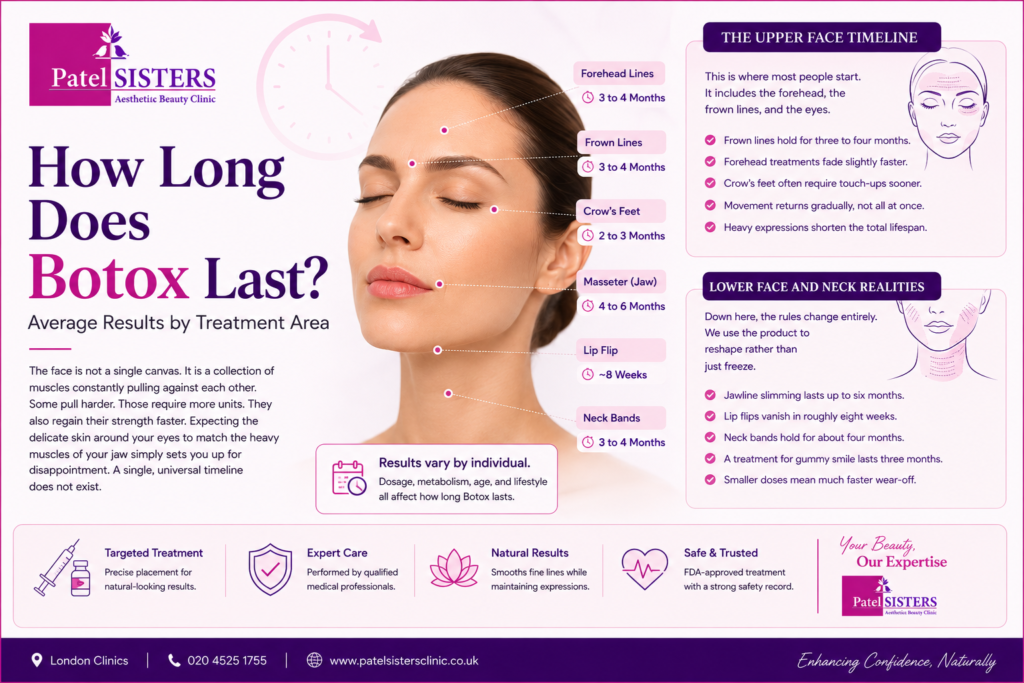
The Upper Face Timeline
This is where most people start. It includes the forehead, the frown lines, and the eyes.
- Frown lines hold for three to four months.
- Forehead treatments fade slightly faster.
- Crow’s feet often require touch-ups sooner.
- Movement returns gradually, not all at once.
- Heavy expressions shorten the total lifespan.
Those frown lines between your eyebrows are thick. They anchor your expressions. The corrugator muscles pull inwards. The procerus pulls down. That is a massive amount of mechanical force. When a practitioner paralyzes them, they have to use enough units to stop multiple directions of pull. Because of that heavy dosing, this area tends to stay frozen longer. Three full months is typical. Four is common. Sometimes patients get lucky with five.
Your forehead works differently. The muscle spanning your upper face is wide and relatively thin. If a clinician freezes it completely, your brow drops. You look tired. So they use lighter, scattered doses. Lighter doses wear off faster. You might see movement returning to your upper forehead around week ten. That is completely normal. The skin here is thin. It reveals every twitch.
The corners of your eyes take a beating. You squint in the sun. You smile. Those small muscles work overtime. Crow’s feet usually show the first signs of returning movement. Expect roughly ten to twelve weeks here.
Lower Face and Neck Realities
Down here, the rules change entirely. We use the product to reshape rather than just freeze.
- Jawline slimming lasts up to six months.
- Lip flips vanish in roughly eight weeks.
- Neck bands hold for about four months.
- A treatment for gummy smile lasts three months.
- Smaller doses mean much faster wear-off.
The masseter muscles in your jaw are massive. They help you chew solid food. When treating them for teeth grinding or facial slimming, practitioners inject large volumes. That high unit count buys you time. You might only need this done twice a year. It changes the actual physical shape of your lower face.
The lip flip sits at the total opposite end of the spectrum. It takes barely any product. Four to six units total. Because the dose is so small, your body clears it incredibly fast. Do not expect a lip flip to survive past the two-month mark. It simply will not happen.
Many clinics pair these injectables with hyaluronic acid dermal fillers to restore lost volume. The fillers last up to eighteen months. The muscle relaxers fade much faster. You have to plan for two completely different maintenance schedules.
What Factors Affect How Long Botox Lasts?
You sit in the same chair as your friend. You pay the same price. You get the exact same brand. Yet her face stays smooth until December, and you are booking a top-up by Halloween. It feels unfair. It happens constantly. The variables are entirely internal.
Your Own Metabolism
Your body treats the injection as a foreign protein. It wants to clear it out.
- High metabolisms clear the product faster.
- Athletes often notice shorter treatment lifespans.
- Intense daily workouts speed up the breakdown.
- Zinc levels might play a small role.
- Thyroid function affects clearance rates slightly.
Think about how you process food. Some people burn calories sitting still. Others hold onto them. The metabolic engine driving that process also processes medications. Runners, weightlifters, and fitness instructors routinely complain about their anti-wrinkle injections fading early. The increased blood flow and rapid cell turnover work against the treatment.
Did you know?
Clinical studies show 0% reduction in Botox duration among highly active, athletic patients who exercise regularly.
Dosage and Dilution
This is the uncomfortable truth about aesthetic pricing. The cost often dictates the dose.
- More units equal a longer lasting freeze.
- Under-dosing guarantees a very quick return.
- Dilution ratios matter to your final outcome.
- Cheap treatments often mean highly diluted product.
- Proper dosing prevents rapid muscle recovery.
The product arrives at the clinic as a dry powder. The practitioner mixes it with saline. The standard ratio is precise. But the clinic controls the syringe. A standard vial contains 100 units. A proper three-area treatment requires roughly 40 to 50 units. That means one vial treats two people safely. If a clinic is running a special and treating four people from one vial, they are diluting it with extra saline. The liquid volume in the syringe looks the same. The active ingredient is slashed in half. This is the primary reason people complain their treatment only lasted six weeks.
Clinics also use the toxin for hyperhidrosis and medical applications like excessive sweating. Those sessions use massive doses. Over a hundred units sometimes. Because the volume is so high, the results often last eight or nine months. Volume dictates longevity.
How to Make Your Botox Results Last Longer
You just spent hundreds of pounds. You probably want that investment to survive the season. Good aftercare does not require expensive creams. It requires patience and strict adherence to a few basic rules. The first day sets the foundation.
The First 24 Hours Matter
The product needs time to bind to your nerve receptors. If you move it, it binds somewhere else.
Step 1: Keep your head upright. For the first four hours, gravity is your enemy. Bending over to tie your shoes or load the dishwasher increases blood pressure in your face. That pressure can push the liquid away from the target muscle.
Step 2: Skip the gym today. Elevating your heart rate increases circulation. You want the product to stay perfectly still. Wait a full day before you break a sweat.
- Do not rub the injection sites.
- Cancel any planned facial massages.
- Avoid hot saunas or steam rooms.
- Sleep flat on your back tonight.
- Skip tight hats or headbands entirely.
Long-Term Maintenance
Once the product sets, your daily habits take over. UV damage destroys collagen. Weak skin shows wrinkles faster, even when the muscle beneath it cannot move.
- Wear sunscreen every single day unconditionally.
- Hydrate your skin to plump fine lines.
- Space your appointments out perfectly over time.
- Avoid aggressive facial rubbing or pulling.
- Manage your stress to stop unconscious frowning.
Stress makes you scowl in your sleep. If you are constantly trying to pull your eyebrows together, those muscles are fighting the medication. They will eventually win. Relax the face.
Botox aftercare and exercise go hand in hand. You can run marathons eventually. Just let the medication settle first.
Signs Your Botox Is Wearing Off and When to Get a Top-Up
Timing your next appointment is tricky. Go too soon, and you risk heavy, unnatural results. Wait too long, and the wrinkles fully return. You have to learn the signals your face sends. It never drops all at once.

Reading the Mirror
The freeze does not vanish overnight. It slowly thaws.
- You notice slight movement returning gradually.
- Makeup starts settling into fine lines again.
- Your brow feels less heavy and tight.
- Morning sleep creases take longer to disappear.
- You catch yourself physically frowning at screens.
You will see the edges soften first. If you had your forehead done, you might notice the outer corners of your eyebrows moving up when you act surprised. The center usually stays frozen the longest. Wait until you have about 50% of your normal movement back before booking your return visit. Injecting into a fully frozen muscle just wastes your money.
Look at your photographs. Sometimes you don’t notice the wear-off in the mirror because you are looking straight ahead. You notice it in candid photos where you are laughing. The outer eye crinkles return. The brow drops slightly. It happens incrementally. A good rule of thumb is the 14-week check. At week 14, take a selfie making a harsh expression. Compare it to your week two selfie. The difference tells you exactly how fast your body clears the product.
People getting migraine treatment face a similar timeline. The headaches creep back slowly. The tension returns to the neck before the full pain hits.
Budgeting for the Top-Up
Understanding the financial reality helps you plan. London pricing can be punishing. Knowing the going rate prevents you from overpaying for your maintenance schedule.
Most reputable places charge by the area. Some charge by the unit. The per-area model is usually safer for your budget. You know exactly what the total will be before the needle touches your skin. Clinics like Patel Sisters offer clear flat rates, which takes the anxiety out of the checkout desk. Never agree to an open-ended per-unit treatment without a strict maximum price agreed upon beforehand.
Conclusion
Knowing how long does botox last lets you control the schedule. The three-month average gives you a baseline to work from. Watch your own movement. Track when the lines actually return. You might find you only need two visits a year instead of four. Protect your skin from the sun. Stop touching your face after the appointment. Let the product do its job.

FAQs :
How long does Botox usually last?
Most patients see a solid three to four months. Smaller areas like the eyes might fade in eight short weeks. Larger doses injected directly into the jaw can last up to six months.
When does Botox start working?
You won’t see anything for the first two days. Around day three or four, the area feels slightly heavy. Maximum freezing happens exactly at the two-week mark.
What causes Botox to wear off faster?
A highly active metabolism burns through the binding quicker than average. Heavy daily exercise routines after injectables speed up the entire physiological process. Squinting constantly in the bright sun also forces the muscle to actively fight the medication.
How can I make my Botox last longer?
Stay completely out of the gym for forty-eight hours post-injection. Wear sunglasses to stop involuntary squinting. Maintain a consistent schedule so the targeted muscle actually weakens over time through controlled atrophy.
Does age affect how long Botox lasts?
Yes. Older patients often retain their results longer because their cellular regeneration happens at a slower pace. Younger patients with rapid cell turnover rebuild their broken nerve pathways much faster.