
Deciding between these two treatments requires understanding they fix entirely different problems. The main difference is that HIFU uses ultrasound energy to lift sagging skin, lasting 12 to 18 months. Botox uses a neuromodulator to relax muscles that cause wrinkles, lasting 3 to 6 months. While HIFU has a higher upfront cost, its longevity often makes it more cost-effective long-term. You want a tighter jawline, or maybe you want fewer forehead lines. Picking the wrong option wastes thousands of pounds. Let’s break down the exact mechanics, expected costs in London clinics, and realistic recovery timelines.
Understanding the Basics: How Do They Work?
Anti-ageing menus look incredibly crowded today. Patients frequently confuse tightening loose tissue with paralysing hyperactive muscles. We need to clear that up right now. Fast. Most articles treat them like interchangeable magic erasers. They’re not. If you try to fix loose skin with a muscle relaxant, you’ll walk away highly disappointed and significantly poorer.
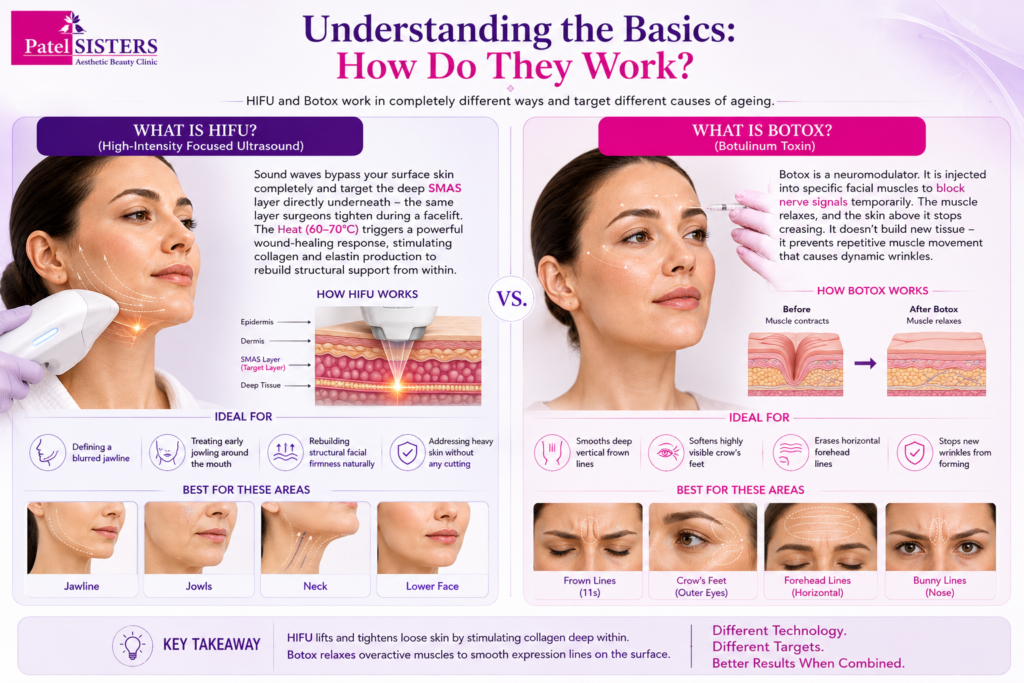
What is HIFU? (High-Intensity Focused Ultrasound)
Sound waves bypass your surface skin completely during this procedure. They target the deep SMAS layer directly underneath. Surgeons manipulate this exact same tissue plane during a surgical facelift. Heat from the wand triggers a massive wound-healing response deep inside your face. Your body rushes to build thick new structural support over the following weeks. It acts like putting fresh scaffolding inside a sagging canvas tent. The heat must reach exactly 60 to 70 degrees Celsius under the skin to denature old proteins and force your system to synthesise fresh ones.
- Ideal for defining a blurred jawline
- Treats early jowling around the mouth
- Rebuilds structural facial firmness naturally
- Addresses heavy skin without any cutting
What is Botox? (Botulinum Toxin)
Neuromodulators operate on an entirely different physical principle. Injectors place tiny amounts of purified protein into specific facial muscles. Nerve signals can’t reach those targeted muscle fibers temporarily. Muscle activity stops cold. Skin resting on top stops folding over itself constantly. Imagine taking the batteries out of a paper-folding machine. Creases eventually smooth themselves out through simple physical rest. You aren’t building anything new here. Every time you frown, facial muscles pull the overlying skin into a crease, much like repeatedly folding a piece of paper. Injections simply stop the folding process. By freezing the muscle, dermal tissue finally gets a vacation from being constantly crushed together.
- Smooths deep vertical frown lines
- Softens highly visible crow’s feet
- Erases horizontal forehead expression lines
- Stops new wrinkles from forming
Which Lasts Longer: HIFU or Botox?
Patience pays off very differently depending on which syringe or machine you choose. A fast fix fades fast. Building real biological tissue takes much longer but sticks around long after you forget about your clinic visit.
HIFU Longevity Expectations
Results develop at a stubbornly slow pace. You might stare in the mirror for eight weeks and see absolutely nothing. Collagen keeps forming quietly for up to six full months after your appointment. That new structural support lasts 12 to 18 months for most healthy adults. Sometimes patients with excellent skin elasticity push that timeframe well beyond two years. One single annual visit usually handles all necessary maintenance. The biological reality is that you’re quite literally growing new parts of your face. Your immune system recognizes the thermal damage caused by the ultrasound wand and sends fibroblasts to the area. Those cells weave fresh, tight collagen meshes across your lower jaw. Because it’s your own tissue, it degrades at the normal rate of human aging rather than breaking down quickly like a synthetic injectable.
- Takes several months to peak
- Lasts well over a year
- Requires very rare clinic visits
- Builds actual permanent collagen strands
Botox Longevity Timelines
You’re buying immediate gratification with this option. Lines start softening visibly within three to seven days. Peak frozen smoothness hits right around week two. Then the biological clock starts ticking backwards immediately. Most people notice faint movement returning at the three-month mark. By month six, the paralytic effect vanishes entirely from your system. You’re back exactly where you started. If you stop injecting, your face simply resumes its normal aging process exactly where it left off.
- Works visibly within a week
- Fades completely within six months
- Needs frequent quarterly clinic top-ups
- Provides temporary cosmetic relief only
Pro Tip: Heavy exercisers metabolize neurotoxins much faster than sedentary patients, meaning your three-month wrinkle fix might only survive eight weeks.
Cost Comparison: Upfront Price vs. Long-Term Value
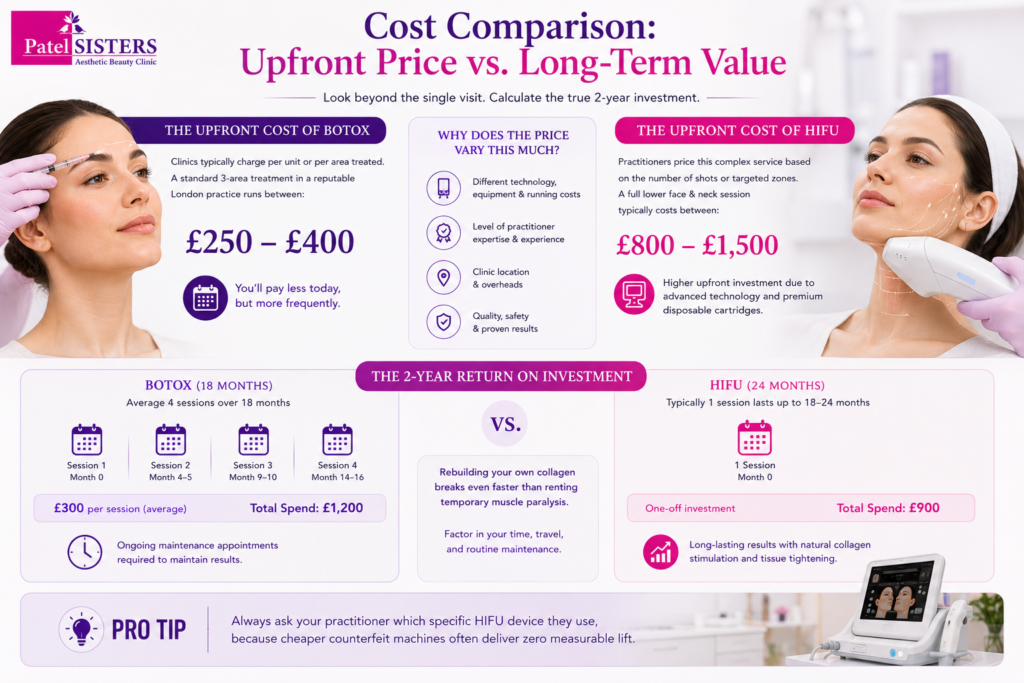
London clinic pricing confuses many first-time aesthetic patients. They see a small number on a price list and assume it represents the cheaper path. Math proves otherwise over a 24-month horizon. But why does the price vary this much? Comparing them accurately requires looking past the single-visit receipt and calculating the true cost of keeping your face looking exactly how you want it to look year-round.
The Upfront Cost of Botox
Clinics typically charge per unit or per area treated. Anti-wrinkle injections (Botox) are commonly priced based on the number of areas treated or units used. A standard three-area treatment in a reputable London practice runs between £250 and £400. That feels highly accessible for a Tuesday afternoon appointment. You’ll pay less money today. You just pay it much more frequently. It acts like a high-interest subscription service for your face.
The Upfront Cost of HIFU
Sticker shock happens constantly during these consultations. Practitioners price this complex service based on the number of fired ultrasound shots or specific targeted zones. A full lower face and neck session sits somewhere between £800 and £1,500. Handing over your credit card hurts initially. The machine itself costs the clinic tens of thousands of pounds to purchase, and the disposable cartridges used for your specific face are incredibly expensive to manufacture.
The 2-Year Return on Investment
Let’s do the actual math for a standard patient. Four neuromodulator sessions over 18 months at £300 each equals £1,200 total spend. Your calendar fills up with maintenance appointments. Compare that to the ultrasound route. Patients endure some mild discomfort along their jawline for forty-five minutes. One solid ultrasound treatment covering that exact same timeframe costs roughly £900 upfront. Rebuilding your own collagen actually breaks even faster than renting temporary muscle paralysis from a syringe. People rarely calculate the invisible cost of their own time spent commuting to quarterly clinic appointments, sitting in waiting rooms, and hiding minor needle bruises from their coworkers four times a year.
Pro Tip: Always ask your practitioner which specific ultrasound device they operate, because cheaper counterfeit machines often deliver zero measurable tissue lift.
Quick Comparison Summary
Reviewing the clinical data side-by-side helps clarify the decision instantly. Both cosmetic procedures definitely earn their stellar reputations. They just serve entirely distinct masters.
HIFU vs. Botox Breakdown Table
| Feature | HIFU | Botox |
| Best For | Sagging skin & foundational lifting | Active expression wrinkles |
| Mechanism | Stimulates collagen via ultrasound | Relaxes specific facial muscles |
| Longevity | 12 to 18+ Months | 3 to 6 Months |
| Results Visible | 2 to 6 Months (Gradual) | 3 to 7 Days (Fast) |
| Average Cost | £800 to £1,500 per session | £250 to £400 per session |
- Easy-to-read clinical comparisons
- Clear financial expectations set firmly
- Realistic timelines for visual results
- Honest mechanical tissue differences explained
Can You Have Both HIFU and Botox?
Mixing aesthetic modalities creates far superior outcomes for rapidly aging faces. A non-surgical facelift often requires treating both gravity and muscle tension simultaneously. One tool can’t fix every problem.
The Combination Strategy
Upper face problems respond beautifully to targeted neuromodulators. Lower face heaviness absolutely needs intense ultrasound energy. A skilled practitioner layers these tools carefully. Practitioners freeze the angry forehead lines. They lift the dropping jowls. You get highly specific facial rejuvenation without ever going under a surgeon’s knife. The combination actually creates a biological feedback loop where relaxed upper muscles stop pulling against the newly tightened lower skin.
- Treats multiple distinct aging signs
- Avoids surgical anesthesia downtime risks
- Customizes your exact facial needs
- Delivers highly natural-looking results
The Timing Rules for Safety
Never book them on the exact same afternoon. Ultrasound devices generate intense subcutaneous heat deep within your tissues. Heat naturally increases local blood flow significantly. Extra blood circulation could easily spread the freshly injected neurotoxin into nearby muscles you definitely want kept active. Nobody wants a drooping eyelid for three months. Schedule your ultrasound appointment first. Wait two to four weeks before letting anyone inject anything into your face. Getting the sequence right prevents disastrous complications.
Did you know? 62% of patients seeking non-surgical facelifts end up combining ultrasound therapy with neurotoxins for optimal facial balancing.
Final Verdict: Which One Is Right For You?
Stop guessing based on heavily filtered social media trends. Your specific tissue density and muscle strength dictate the correct path forward. Choosing Botox for sagging jowls is like trying to fix a flat tire by painting the hubcap.
Making the Clinical Call
Pick the needle for quick fixes of expression lines right before a major wedding. Choose the wand for foundational lifting and long-term, highly natural collagen production. Dermal fillers may also be considered when adding volume or enhancing specific facial areas is the main goal.
- Stop wasting time researching online
- Book your specific facial assessment
- Get a truly personalized treatment
Skin changes constantly depending on your stress levels and hormone fluctuations. What worked brilliantly five years ago might not work today. Have a medical professional evaluate your specific SMAS layer thickness and resting muscle strength. You deserve brutally honest answers from someone looking directly at your actual face. Book an expert consultation to map out a strategy that fits your actual biology instead of a magazine article.
Why Choose Patel Sisters Clinic for Your Treatment?
Choosing between HIFU and Botox should begin with knowing what your face really needs. I focus on your concerns instead of giving the same treatment to every person. At Patel Sisters Clinic we look at your skin, your facial shape, and your treatment goals before recommending the choice for you. You can also book a consultation to discuss your treatment needs before making a decision.

Professional Treatment Approach
HIFU and Botox work in different ways, so choosing the right treatment matters. HIFU focuses on skin tightening and lifting while Botox targets muscle movement and expression lines.
Our approach is based on the concern you want to address, your desired result, and your individual facial needs.
Your Treatment, Your Goals
We take time to understand what you want to improve before recommending a treatment.
Step 1: Discuss your main skin or facial concerns.
Step 2: Assess your facial structure and treatment needs.
Step 3: Explain whether HIFU, Botox, or a combination may suit you.
Step 4: Create a personalized treatment plan based on your goals.
Conclusion
Choosing between HIFU and Botox is not about which treatment is cheaper. They work in ways and fix different problems. HIFU might be better for tightening skin and lifting it. Botox can make lines on the face softer. These lines happen because of muscle movement. At Patel Sisters Clinic we look at your problems and what you want to achieve with treatment before suggesting something. There are clinics in places in London. Our team can help you learn which treatment is right for you.
Frequently Asked Questions About HIFU vs. Botox
1. Does HIFU give immediate results?
HIFU results develop gradually, showing right away. Improvements in skin firmness can become more noticeable after weeks and months.
2. How much does HIFU cost in London?
A full face and neck HIFU treatment in London usually costs between £800 and £1,500. The final price can vary depending on the clinic and the exact treatment area being treated.
3. How soon can you see Botox results?
Botox can start showing visible changes within a few days. Results typically become more noticeable within 3 to 7 days.
4. Can HIFU help define the jawline?
HIFU helps improve firmness around the face. HIFU may also support a defined jawline depending on your individual facial structure.
5. How Long Does a HIFU or Botox Treatment Take?
Treatment time depends on the areas being treated and the treatment plan. HIFU usually takes longer because multiple areas may require ultrasound treatment, while Botox is generally quicker when treating specific facial areas.