
You check the mirror. The mark remains right where it was yesterday. Fading these stubborn patches requires serious medical intervention, not just expensive pharmacy oils. We break down the actual biology of tissue repair and scar treatment. We look at the real UK prices.
Six months. Maybe one year. That’s usually how long it takes for wounded skin to settle down in its final configuration.
People purchase fancy silicone gels and hope to erase them by Friday night.
It doesn’t work that way. Damaged tissue can’t be easily fixed. When skin is injured, your body slaps together a quick fix, not the original blueprint. You need patience. If every beauty magazine on your nightstand (and probably the stack on your doctor’s desk) insists on the vitamin E massage at least once a day, don’t take it at face value.
If anything, slathering oil on a thick bundle of collagen simply yields a shiny ball.
The truth about flattening your wounds is often brutally simple and requires a counterintuitive method-essentially you’re getting the body to unravel the repair. You may spend weeks poring over esoteric dermatology websites, order a pricey 80-pound tub of supposedly clinical grade silicone and layer it meticulously day and night, only to stare in amazement at the unchanged, bright pink river running through your deltoid. It stings – mentally as well as emotionally.
I’ve seen patients empty their pockets on products they are so certain will erase those ugly battle scars.
They never do. You need to go in there and do something with the injury.
Different Types of Scar Explained
But don’t try to treat marks exactly the same regardless. A light brown flat mark will respond quite differently than a large red raised, inflamed keloid. If they are both treated exactly the same you can’t help but fail to see improvement. The first step is to recognize what you are seeing. These are types of scars.
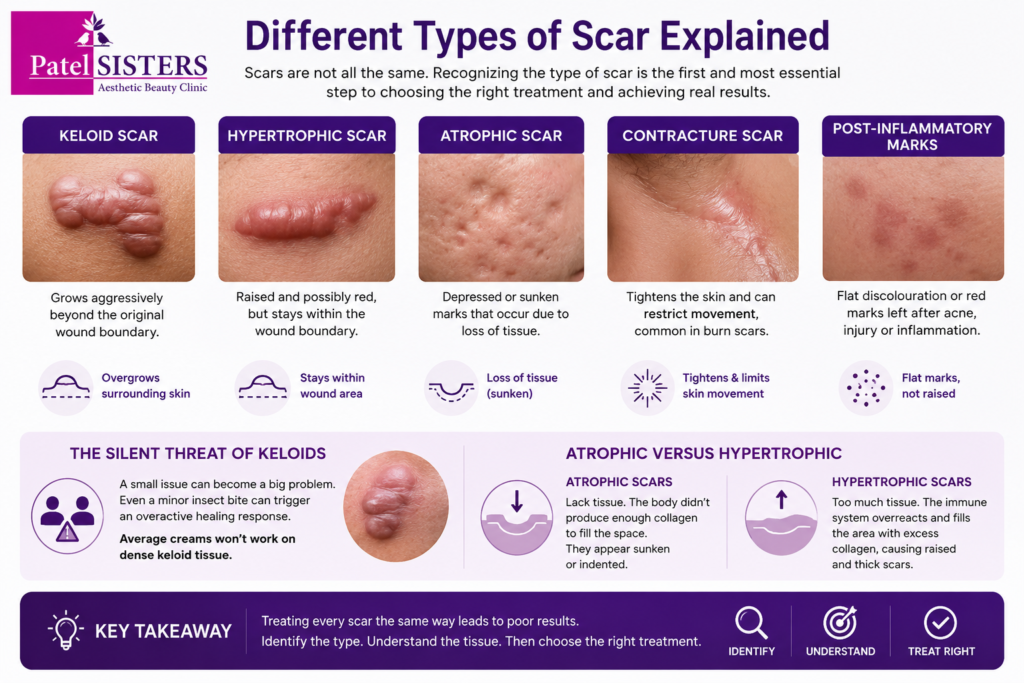
Identifying The Tissue
Let us categorize the most common formations.
- Keloids grow aggressively beyond the original wound.
- Hypertrophic marks stay raised but strictly contained.
- Atrophic indentations look like sunken little pits.
- Contractures tighten the skin over large burns.
- Post-inflammatory marks leave flat red shadows.
The Silent Threat of Keloids
Occasionally a small issue becomes a bigger thing. A minor mosquito bite on your chest may cause a healing process to explode. No average fading cream will be enough for dense tissues. You might use onion essence for a year and get no improvement to speak of since you’re tackling the wrong microscopic process.
Atrophic Versus Hypertrophic
Your choice directly determines what treatment plan your physician chooses. Atrophic marks simply lack tissue, where your body failed to make enough collagen to support the space it formed. Hypertrophic marks are just the opposite, where your immune system got flustered and overcompensated, filling the area with a whole bunch of excess collagen. A tissue stimulating laser will only feed the hypertrophic bump and continue to encourage it to grow.
What Causes Scar?
Your skin is like a tightly woven mat of identical fibers. A deep slice creates an open wound right through the center. The body goes into panic mode and dumps in lots of quick-dry, cheap collagen to slap over the tear. It’s a bad, sloppy repair job.
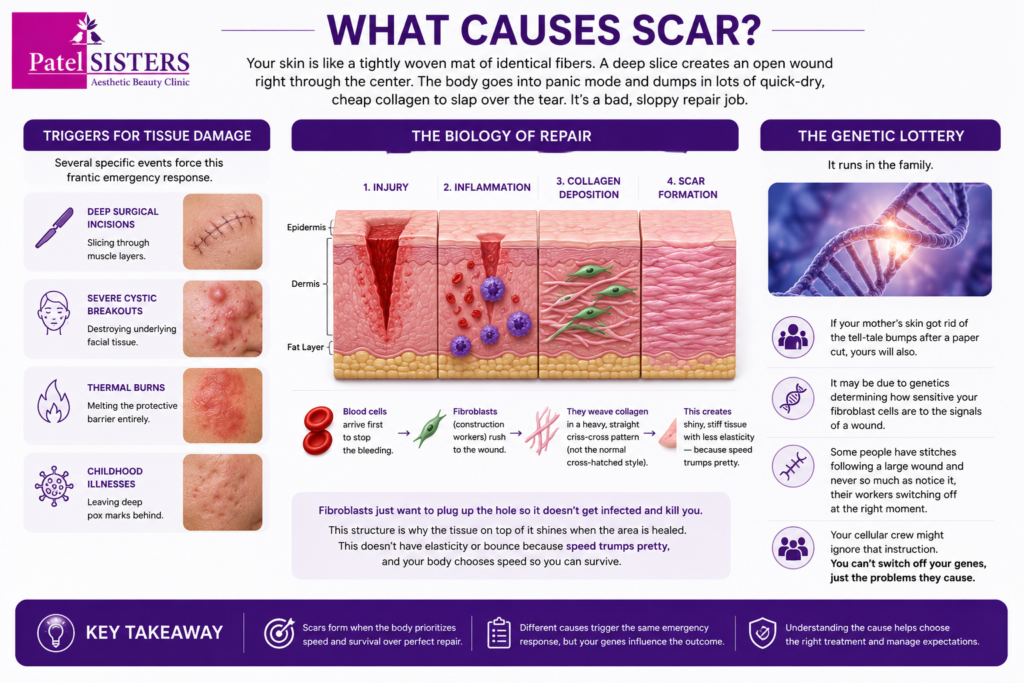
Triggers for Tissue Damage
Several specific events force this frantic emergency response.
- Deep surgical incisions slicing through muscle layers.
- Severe cystic breakouts destroying underlying facial tissue.
- Thermal burns melting the protective barrier entirely.
- Childhood illnesses leaving deep pox marks behind.
The Biology of Repair
Blood cells get their, and then fibroblast cells – the cellular equivalent of construction workers – get theirs. Fibroblasts just want to plug up the hole so it doesn’t get infected and kill you, so they weave collagen into a heavy, straight criss-cross instead of the typical cross-hatched style you find everywhere else in the body. This structure is why the tissue on top of it shines when the area is healed. This doesn’t have elasticity or bounce because speed Trumps pretty, and your body chooses speed so you can survive.
The Genetic Lottery
It runs in the family. If your mother’s skin got rid of the tell-tale bumps after a paper cut, yours will also. Whether you do may be due to genetics determining how sensitive your fibroblast cells are to the signals of a wound. Others may have stitches following a large wound and never so much as notice it, their workers switching off at the right moment. Your cellular crew might ignore that instruction. You can’t switch off your genes, just the problems they cause.
What Is Scar Treatment? and How Does It Work?
For now, all you need to know is that they don’t fade themselves like a bruise and, clinical procedures don’t really conjure your flesh into a different pattern: They essentially attack hardened collagen using brute physical force or harsh chemicals. Small issues call for light weapons, and clinical ones carry heavier weaponry.
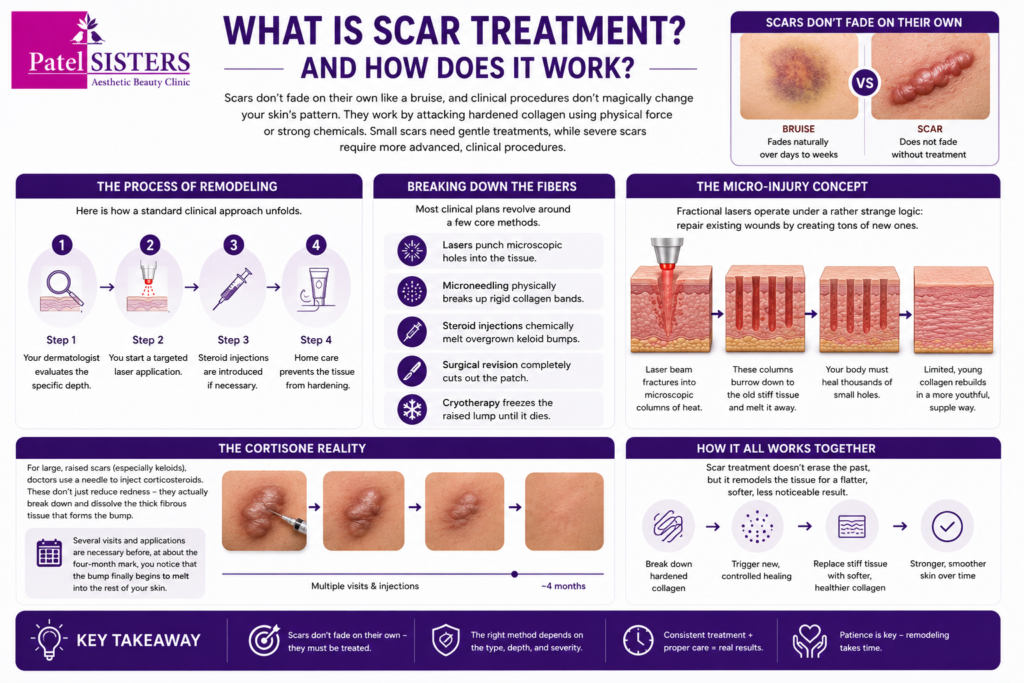
The Process of Remodeling
Here is how a standard clinical approach unfolds.
Step 1 : Your dermatologist evaluates the specific depth.
Step 2 : You start a targeted laser application.
Step 3 : Steroid injections are introduced if necessary.
Step 4 : Home care prevents the tissue from hardening.
Breaking Down The Fibers
Most clinical plans revolve around a few core methods.
- Lasers punch microscopic holes into the tissue.
- Microneedling physically breaks up rigid collagen bands.
- Steroid injections chemically melt overgrown keloid bumps.
- Surgical revision completely cuts out the patch.
- Cryotherapy freezes the raised lump until it dies.
The Micro-Injury Concept
Fractional lasers operate under a rather strange logic, repair existing wounds by creating tons of new ones. The laser beam fractures into dozens of microscopic columns of heat. These columns burrow their way down to the old stiff tissue and instantly melt away that tissue. Now your body has to heal thousands of small little holes, and since your body tends to have a limited pool of young, soft collagen, it goes about rebuilding in an more youthful and supple fashion to seal all of the microscopic lesions.
The Cortisone Reality
In the case of large lumps, doctors typically use a needle to draw out the contents. Unlike redness-fading inflammation-busting shots, corticosteroids will actually break up and eliminate the thick fibrous tissues that compose the bump. Several visits and applications are necessary before, at about the four-month mark, you notice that the bump finally begins to melt into the rest of your skin.
Why Scar treatment is must needed?
Just Leaving it There “If it doesn’t affect function, I’ll just leave it.” The result: a permanently thickened rope on the skin which limits mobility. And the stress: going through your whole day, putting on a scarf around your neck to make it less prominent.
Beyond The Visual Impact
You treat the condition to protect your physical mobility.
- Tight contractures physically limit your joint movement.
- Raised lumps catch on clothing and bleed.
- Deep pits trap makeup and daily dirt.
- Constant itching disrupts your normal sleep cycles.
The Uncomfortable Truth About Erasure
Here’s the kicker though. Once a real, deep dermal tear has healed, you can no longer see the trace with a laser any more than you can get rid of old surgery scars by dabbing silicone onto them and wishing it away. You’ve already traumatized your skin into remodeling. You’re just replacing something ugly and obvious with something way more subtle. There are only very very few truly flat outcomes with surgery and lasers, or there are lying about.
Psychological Toll
Everyone underestimates just how exhausting this is. Having a stigma around not getting into swimming pool because a surgical scar runs up your stomach sounds kind of like a lot for someone with clear skin; it’s an every day average Tuesday for a person who is dealing with a sizable keloid. You spend more time trying to figure out what kind of lighting is going to reveal the scar you’re worried you see than just to try to find natural lighting as you’re just walking. You learn how to style your shirts to cover it the same way you’ve learned to tilt your head to just show the collar at the right spot. You get tired of checking your chin angle when meeting new people.
How Much Does Scar Treatment Cost in the UK?
Your postcode will wildly affect the cost; a single consultation in a tiny town in the north of the country will cost a tiny fraction of Harley street, with London always at the top end of the tree. But why such a price discrepancy? Because there are three things that the procedure is actually being paid for; it’s the doctor’s specific skills, the high maintenance of the equipment, and the rent.
UK Clinic Pricing Breakdown
Here is a rough guide to what you might spend.
| Treatment Type | Average UK Price | London Price Reference |
| Initial Consultation | £100 to £250 | £200 to £400 |
| Steroid Injections | £150 to £300 | £250 to £450 |
| Fractional Laser | £300 to £800 | £500 to £1200 |
| Microneedling Course | £400 to £900 | £600 to £1500 |
The Hidden Costs
The price isn’t just for the clinic. It is for the soft silicone scrubber wash which you’re instructed to buy afterwards. It is the higher degree sunscreen to ensure you don’t have all those light burning your skin which the powerful laser has render you hyper-sensitive towards it. That cost builds very quickly as the average person shells out more than a grand for a full course of treatment.
The Public System Wait
There’s NHS. It’s just that the wait times are terrible and you generally have to have severe physical pain to get a specialist there – they reject purely aesthetic complaints outright because it impacts movement. I think a lot of people also go to private clinics just because it seems to ‘put’ the issue on time out.
Why Patel Sisters Clinic is the Best for Scar Treatment
And then you’re left with… what happens when the active wound shuts itself down: The scars and irregular texture remain exceptionally resistant. High-Intensity Focused Ultrasound paired with microneedling precision are perfect for exactly that problem, and this set of combined overlapping technologies have been central to a medical background for The Patel Sisters Clinic based in London.
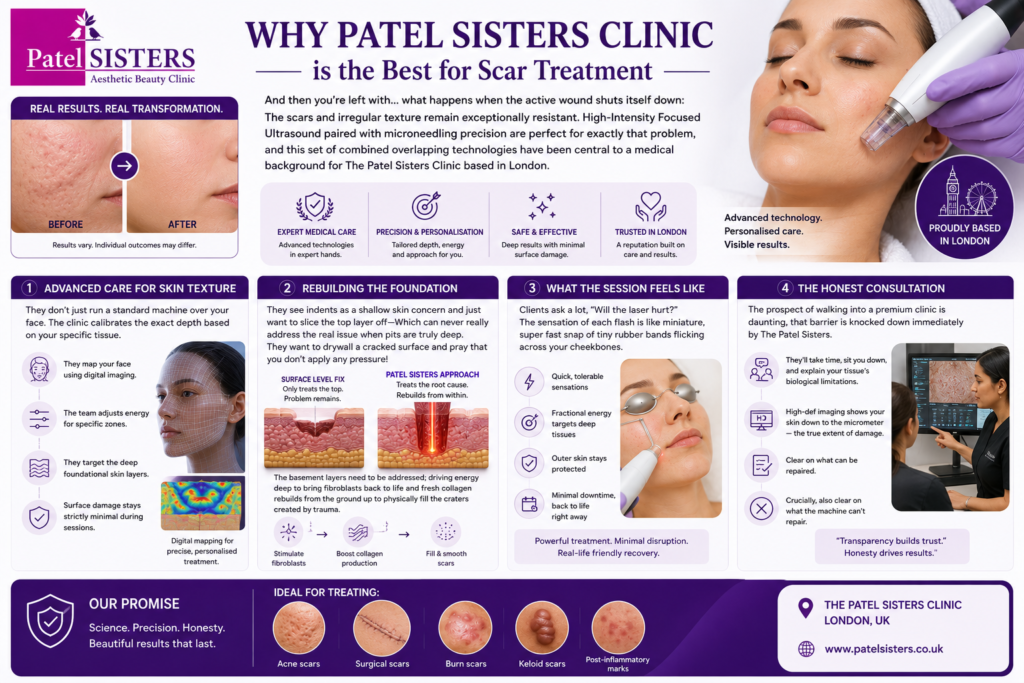
Advanced Care for Skin Texture
They don’t just run a standard machine over your face. The clinic calibrates the exact depth based on your specific tissue.
- They map your face using digital imaging.
- The team adjusts energy for specific zones.
- They target the deep foundational skin layers.
- Surface damage stays strictly minimal during sessions.
Rebuilding The Foundation
They see indents for a shallow skin concern and just want to slice the top layer off-Which can never really address the real issue when pits are truly deep. They want to drywall a cracked surface and pray that you dont apply any pressure! The Patel Sisters approach it with another, more fundamental perspective. The basement layers need to be addressed; driving energy to really bring those fibroblasts back to life and fresh collagen needs to be building from the ground floor to help the physically fill the craters created by trauma.
What the Session Feels Like
Clients ask a lot, “Will the laser hurt?” The sensation of each flash is like miniature, super fast snap of tiny rubber bands flicking across your cheekbones. And it’s quick, because the fractional light energy is directed at your deep tissues, most of your outer skin layer isn’t compromised so you can walk straight out the door and back into your normal life.
The Honest Consultation
The prospect of walking into a premium clinic is daunting, that barrier is knocked down immediately by The Patel Sisters. They’ll take time, sit you down, and tell you what that tissue has biologically got limitations on it before advising a single protocol. The read out you can get on a high-def screen showing your skin tissue down to micro meter showing the extent of your damage build an automatic connection; telling you what they will be able to repair. Crucially also, what the machine can’t repair.
Conclusion
Reconstructing damaged tissue is a serious cash-and months-and serious, no two ways about it. It burns from the laser and it stings from the needles, and in the beginning your skin may indeed appear much worse for a week, at least, before it looks better. You simply have to tolerate the irritation inherent in that journey of repair, until the texture finally begins to yield.

What is scar treatment?
It is a combination of physical and chemical procedures designed to break down hard collagen and force your body to build smoother, flatter tissue over time.
What causes Scar?
A deep injury tears the dermis apart. The body panics and rushes stiff collagen to plug the hole quickly, resulting in a messy, mismatched patch of hard tissue.
What are the main types of Scar?
Keloids, hypertrophic bumps, atrophic pits, burn contractures, and flat post-inflammatory marks make up the primary categories. Each requires a slightly different approach to flatten successfully.
Is Scar treatment safe for sensitive skin?
Yes, provided you start with very conservative energy levels. The doctor applies a lighter laser setting initially, letting your skin build tolerance before increasing the intensity.
How much does professional acne treatment cost in the UK?
Expect to pay anywhere from £150 for basic cortisone injections up to £1200 per session for advanced fractional laser therapies in central London clinics.