
You wake up. The mirror shows another massive breakout. You just want it gone. Finding the right fix takes trial and error, but understanding your skin actually helps. We look at what triggers these spots. We break down the real costs in the UK. Let's do your acne treatment.
Introduction
Three weeks. Four maybe. This is usually around the time a new regime may begin to take effect. We see an advert for skin products that seem miraculous, buy a whole cabinet full and hope for clear skin by Tuesday. It’s not that quick. There’s no real shortcut; patience must prevail. Your skin works on a very slowly moving dial, rather than a switch.
You need to grit your teeth and wait. Many would suggest the obvious: to scrub at your face as much as possible. This does not actually address the underlying biological mechanism for the eruption in the first place, and you will only achieve a red, inflamed face with spots. For clear skin the real, albeit somewhat boring, truth lies in one active ingredient, used religiously for months and months on end.
You then spend three days trawling through reviews, get rid of £60 for a tiny glass dropper bottle promising the world, smear the fluid on religiously for a month, and then get up to find a cluster of new painful lumps along your jaw line, it is sore on more than just one level. We have seen clients that have spent thousands of pounds on serums and continue in the belief the next one will hold the answers. You do not need cosmetics you need to see a doctor.
Different Types of Acne Explained
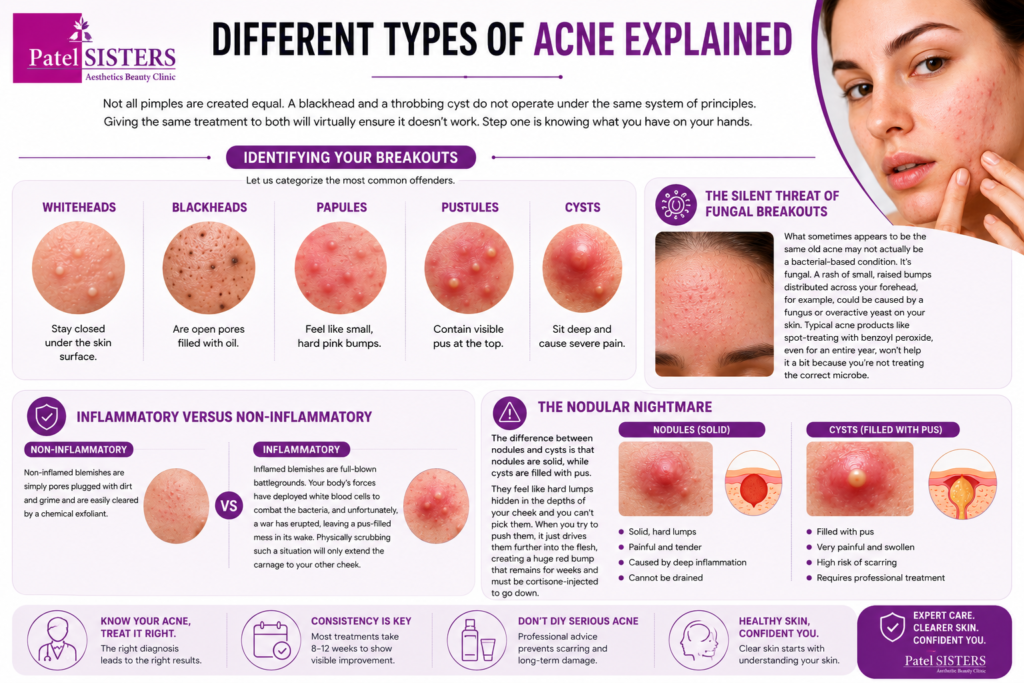
Not all pimples are created equal. A blackhead and a throbbing cyst do not operate under the same system of principles. Giving the same treatment to both will virtually ensure it doesn’t work. Step one is knowing what you have on your hands.
Identifying Your Breakouts
Let us categorize the most common offenders.
- Whiteheads stay closed under the skin surface.
- Blackheads are open pores filled with oil.
- Papules feel like small, hard pink bumps.
- Pustules contain visible pus at the top.
- Cysts sit deep and cause severe pain.
The Silent Threat of Fungal Breakouts
What sometimes appears to be the same old acne may not actually be a bacterial-based condition. It’s fungal. “A rash of small, raised bumps distributed across your forehead, for example, could be caused by a fungus or overactive yeast on your skin. Typical acne products like spot-treating with benzoyl peroxide, even for an entire year, won’t help it a bit because you’re not treating the correct microbe.
Inflammatory Versus Non-Inflammatory
This information influences your strategy for treating each spot. Non-inflamed blemishes are simply pores plugged with dirt and grime and are easily cleared by a chemical exfoliant. Inflamed blemishes are full-blown battlegrounds. Your body’s forces have deployed white blood cells to combat the bacteria, and unfortunately, a war has erupted, leaving a pus-filled mess in its wake. Physically scrubbing such a situation will only extend the carnage to your other cheek.
The Nodular Nightmare
The difference between nodules and cysts is that nodules are solid, while cysts are filled with pus. They feel like hard lumps hidden in the depths of your cheek and you can’t pick them. When you try to push them, it just drives them further into the flesh, creating a huge red bump that remains for weeks and must be cortisone- injected to go down.
What Causes Acne?
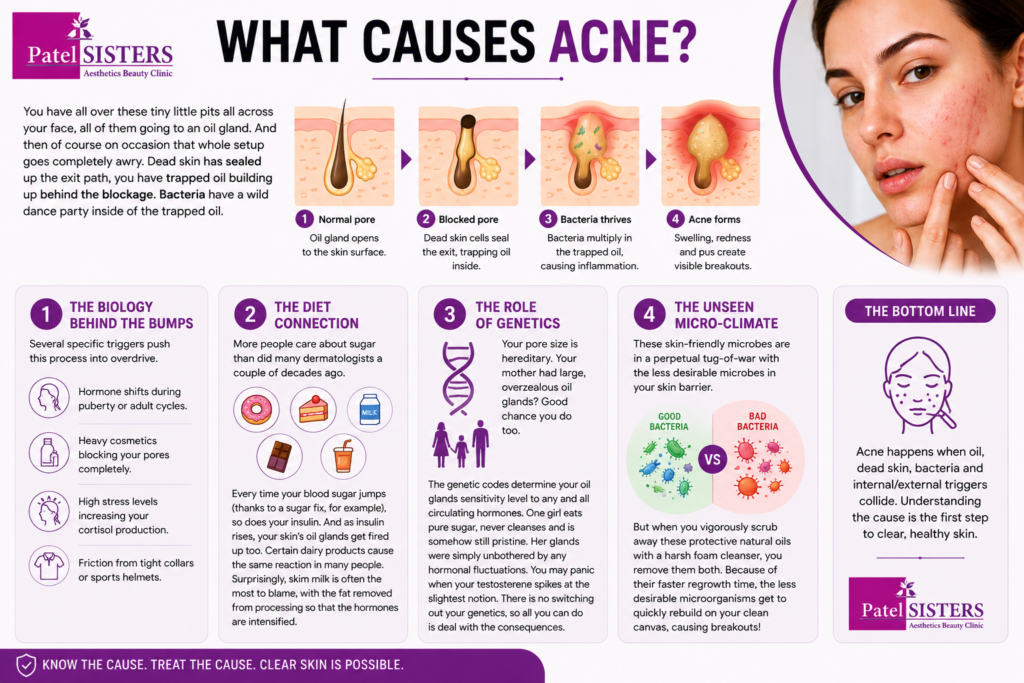
You have all over these tiny little pits all across your face, all of them going to an oil gland. And then of course on occasion that whole setup goes completely awry. Dead skin has sealed up the exit path, you have trapped oil building up behind the blockage. Bacteria have a wild dance party inside of the trapped oil. Let’s see what the causes of acne are.
The Biology Behind the Bumps
Several specific triggers push this process into overdrive.
- Hormone shifts during puberty or adult cycles.
- Heavy cosmetics blocking your pores completely.
- High stress levels increasing your cortisol production.
- Friction from tight collars or sports helmets.
The Diet Connection
More people care about sugar than did many dermatologists a couple of decades ago. Every time your blood sugar jumps (thanks to a sugar fix, for example), so does your insulin. And as insulin rises, your skin’s oil glands get fired up too. Certain dairy products cause the same reaction in many people. Surprisingly, skim milk is often the most to blame, with the fat removed from processing so that the hormones are intensified.
The Role of Genetics
Your pore size is hereditary. Your mother had large, overzealous oil glands? Good chance you do too. The genetic codes determine your oil glands sensitivity level to any and all circulating hormones. One girl eats pure sugar, never cleanses and is somehow still pristine. Her glands were simply unbothered by any hormonal fluctuations. You may panic when your testosterone spikes at the slightest notion. There is no switching out your genetics, so all you can do is deal with the consequences.
The Unseen Micro-Climate
These skin-friendly microbes are in a perpetual tug-of-war with the less desirable microbes in your skin barrier. But when you vigorously scrub away these protective natural oils with a harsh foam cleanser, you remove them both. Because of their faster regrowth time, the less desirable microoganisms get to quickly rebuild on your clean canvas, causing breakouts!
What Is Acne Treatment? and How Does It Work?
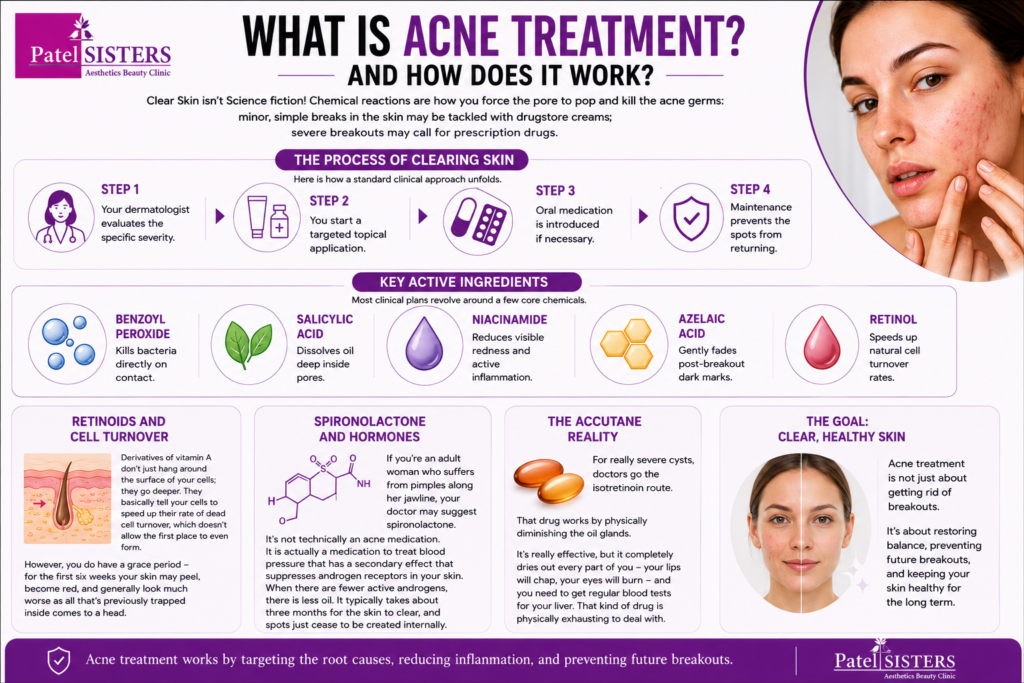
Clear Skin isn’t Science fiction! Chemical reactions are how you force the pore to pop and kill the acne germs: minor, simple breaks in the skin may be tackled with drugstore creams; severe breakouts may call for prescription drugs.
The Process of Clearing Skin
Here is how a standard clinical approach unfolds.
Step 1: Your dermatologist evaluates the specific severity.
Step 2: You start a targeted topical application.
Step 3: Oral medication is introduced if necessary.
Step 4: Maintenance prevents the spots from returning.
Key Active Ingredients
Most clinical plans revolve around a few core chemicals.
- Benzoyl peroxide kills bacteria directly on contact.
- Salicylic acid dissolves oil deep inside pores.
- Niacinamide reduces visible redness and active inflammation.
- Azelaic acid gently fades post-breakout dark marks.
- Retinol speeds up natural cell turnover rates.
Retinoids and Cell Turnover
Derivatives of vitamin A don’t just hang around the surface of your cells; they go deeper. They basically tell your cells to speed up their rate of dead cell turnover, which doesn’t allow the first place to even form. However, you do have a grace period – for the first six weeks your skin may peel, become red, and generally look much worse as all that’s previously trapped inside comes to a head.
Spironolactone and Hormones
If you’re an adult woman who suffers from pimples along her jawline, your doctor may suggest spironolactone. It’s not technically an acne medication. It is actually a medication to treat blood pressure that has a secondary effect that suppresses androgen receptors in your skin. When there are fewer active androgens, there is less oil. It typically takes about three months for the skin to clear, and spots just cease to be created internally.
The Accutane Reality
For really severe cysts, doctors go the isotretinoin route. That drug works by physically diminishing the oil glands. It’s really effective, but it completely dries out every part of you – your lips will chap, your eyes will burn – and you need to get regular blood tests for your liver. That kind of drug is physically exhausting to deal with.
Why acne treatment is must needed?
Just leave severe breakouts alone. That might be all natural but it usually also creates physical scarring that lasts. Emotional scarring can be just as devastating though – because you can’t really step out in the house looking forward to feeling it throb before your alarm is even off.
Preventing Long-Term Damage
You treat the condition to protect your future skin.
- Deep cysts destroy healthy tissue underneath.
- Dark spots linger long after pimples fade.
- Constant inflammation ages your face prematurely.
- Self-esteem takes a massive, unnecessary hit.
The Uncomfortable Truth About Scarring
This is the detail that flips the script. You will not fill an ice-pick scar once the real, deep wound has developed. There’s no cream in existence. Topical collagen doesn’t penetrate: the skin barrier exists for exactly that reason – to prevent large proteins from entering. It is not something that will absorb the cosmetic version of itself. You need to do actual damage for the skin to heal.
Psychological Toll
People really do not realize how mentally tiring it is. Cancelling plans because you have a nasty cyst popped up on your chin sounds ridiculous to a person that has a perfectly clear face, but to a person who has battled acne their whole life, cancelling because a cyst broke out on your chin and you will have nothing on display at the party to distract is just Tuesday. You analyze lighting in public bathrooms constantly. Skin helps reduce the creep social anxiety that comes with acne too.
How Much Does Acne Treatment Cost in the UK?
Prices really can swing on location. You can have a simple consultation at a small town practice for much less than seeing a skin specialist on Harley Street. London prices are always at the most expensive end of the scale. Why the big price difference? The fact is, three things are being priced – and only one is the product itself – you pay for the time, the rent and the chemical peel/laser.
UK Clinic Pricing Breakdown
Here is a rough guide to what you might spend.
| Treatment Type | Average UK Price | London Price Reference |
| Initial Consultation | £50 to £150 | £150 to £250 |
| Chemical Peels | £80 to £200 | £150 to £350 |
| Laser Therapy | £150 to £300 | £250 to £500 |
| Prescription Meds | £20 to £50 | £30 to £80 |
The Hidden Costs
You’re not just paying for the visit. You’re paying for the post-visit neutral cleaner that comes after. You’re paying for the 50-level SPF since all those chemical peels are now making you sensitive to light like a vampire. It starts to add up. For most, it’s at least a £500 before you actually establish some lasting habits.
NHS Versus Private Care
There are solutions via the NHS and you could find the drugs are on standard prescription. However, you’d encounter a long NHS waiting list as it usually takes anywhere between six to twelve months depending on your region to get an appointment with an NHS dermatologist. Meanwhile your body gets on with making new cysts and new scars.
Why Patel Sisters Clinic is the Best for Acne Treatment
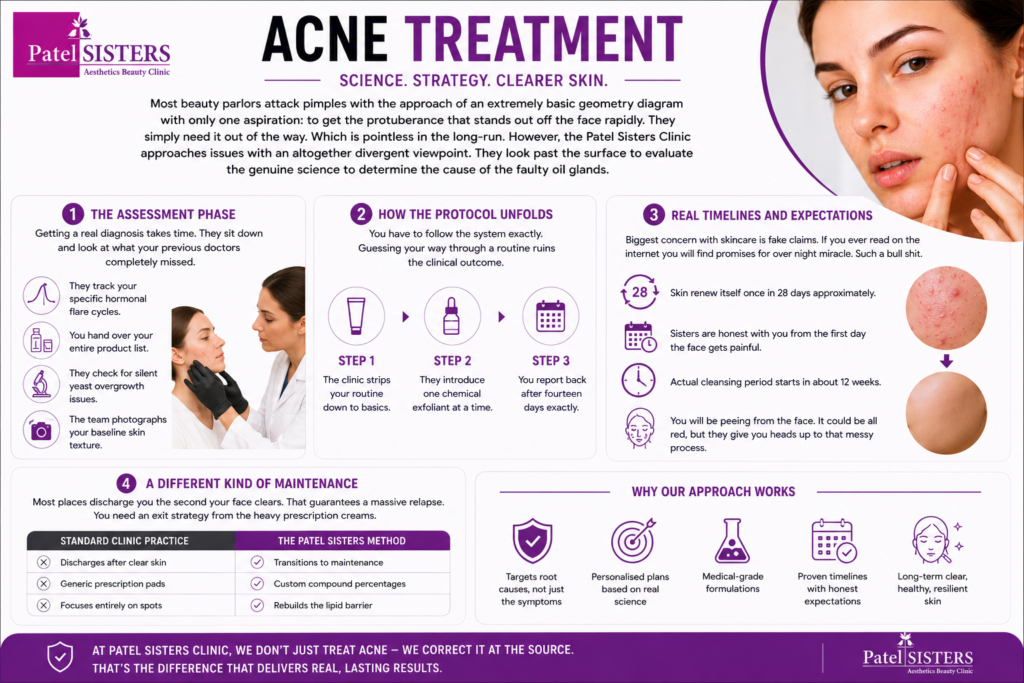
Most beauty parlors attack pimples with the approach of an extremely basic geometry diagram with only one aspiration: to get the protuberance that stands out off the face rapidly. They simply need it out of the way. Which is pointless in the long-run. However, the Patel Sisters Clinic approaches issues with an altogether divergent viewpoint. They look past the surface to evaluate the genuine science to determine the cause of the faulty oil glands.
The Assessment Phase
Getting a real diagnosis takes time. They sit down and look at what your previous doctors completely missed.
- They track your specific hormonal flare cycles.
- You hand over your entire product list.
- They check for silent yeast overgrowth issues.
- The team photographs your baseline skin texture.
How the Protocol Unfolds
You have to follow the system exactly. Guessing your way through a routine ruins the clinical outcome.
Step 1: The clinic strips your routine down to basics.
Step 2: They introduce one chemical exfoliant at a time.
Step 3: You report back after fourteen days exactly.
Real Timelines and Expectations
Biggest concern with skincare is fake claims. If you ever read on the internet you will find promises for over night miracle. Such a bull shit.Skin renew itself once in 28 days approximately. Sisters are honest with you from the first day the face gets painful.Actual cleansing period starts in about 12 weeks. You will be peeing from the face. It could be all red, but they give you heads up to that messy process.
A Different Kind of Maintenance
Most places discharge you the second your face clears. That guarantees a massive relapse. You need an exit strategy from the heavy prescription creams.
| Standard Clinic Practice | The Patel Sisters Method |
| Discharges after clear skin | Transitions to maintenance |
| Generic prescription pads | Custom compound percentages |
| Focuses entirely on spots | Rebuilds the lipid barrier |
Conclusion
Clear skin isn’t cheap or quick. The treatments are itchy, sting, and make your skin a mess before they start cleaning it up. You have to deal with that lingering hope with each product, waiting and seeing if THIS is the thing. Change up the regime until you find yours.

FAQs:
What is acne treatment?
It’s a blend of both oral medications and a topical cream that will help control the production of oil on your skin, get rid of bacteria, and promote faster skin cell turnover. Physicians carefully choose which chemical matches the exact breakout you are experiencing.
What causes acne?
When the pore is blocked with the trapped oil and skin cells, the environment gets to be an optimal place for bacteria. Hormonal changes as well as great stress trigger precisely these things, in general.
What are the main types of acne?
There are basically 6 types of spots: whiteheads, blackheads, papules, pustules, nodules and deep cysts, each and every of which necessitates a rather different treatment.
Is acne treatment safe for sensitive skin?
Yeah as long as you start on very low doses of the active ingredients. You apply the product twice a week at the start until your skin gets used to it.
How much does professional acne treatment cost in the UK?
Expect prices ranging from around £50 for a basic session to £500 a session for the most advanced lasers in central London. You may also have the additional cost of the ongoing monthly prescription fee.